

InkPoster vs Canvas Print: Which Belongs on Your Wall
The real question when comparing a digital art frame like InkPoster to a canvas print is usually about how you want to use it: do you want one fixed piece on your wall for years, or the option to flexibly change the art?
Put simply: a canvas print is one fixed image with woven texture; InkPoster is a matte, backlight-free and cable-free display holding a changeable library of 2,000+ artworks, and giving look and feel of a framed print, not a screen. The rest comes down to how you want to live with the wall.
InkPoster’s screen reflects room light the way a real print does, with no glare and no glow, and because the battery lasts up to a year per charge — drawing power only when the image changes — it hangs anywhere without a cable or a nearby outlet.
That makes the comparison to canvas closer than it is with most digital displays, as Engadget noted:
The colors pop a lot more than you might expect from an e-paper display, and you’re able to see brush strokes in the paintings.
Canvas and InkPoster serve different needs, and the useful comparison goes beyond “changeable versus fixed” into room type, art style, and how much technology you want involved.
What You’re Actually Comparing
A canvas print is ink or pigment on fabric stretched over a wooden frame — a fixed artwork that you choose to live on your wall. A digital art frame adds the freedom to change that static object.
InkPoster is a digital art frame, but it’s closer to canvas than most digital displays, because it uses color E Ink — a color ePaper technology — so the image is seen in reflected light rather than from a glowing panel. The image stays in view even when InkPoster is off, and from a normal viewing distance it reads more like framed wall art than a lit device. In daylight InkPoster’s screen responds to the room the way a print does, and in evening light it does not become the brightest object in view.
Where canvas adds surface warmth through its fabric weave, InkPoster offers a matte, paper-like format that suits those who want rotating art without constant power or visible cords.
What a Canvas Print Offers
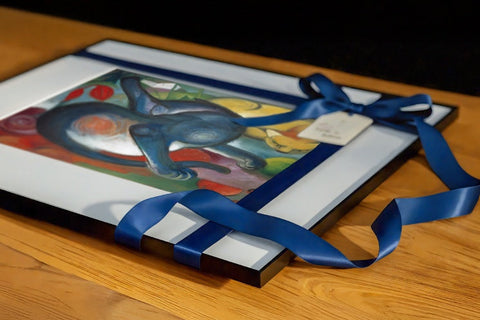
Image: Franz Marc. Zwei Katzen, blau und gelb. Courtesy of Kunstmuseum Basel. sammlungonline.kunstmuseumbasel.ch. Public Domain.
Physical weave. Canvas has a surface: ink sits in the weave of the fabric, creating a depth that shifts slightly with angle and light, so a canvas print of an oil painting carries some of that tactile feel into the copy. At close range, InkPoster reveals a subtle print texture that brings added depth and a natural, tactile quality to the artwork, reminiscent of a fine lithographic print. At the same time, InkPoster offers a smooth, matte surface, which suits clean-lined rooms and artwork with crisp detail.
Zero technology. InkPoster lets you manage updates from your phone whenever you want to change the image. It brings a curated library, a glare-free display, and the freedom to easily change the artwork on your wall.
Long-term use as a feature. Keeping the same piece on the wall can create a sense of familiarity over time, while a library of thousands offers the freedom to change the artwork whenever the mood or space calls for something new.
What InkPoster Offers
The ability to change the art. InkPoster includes up to 2,000 curated and licensed artworks available in the native app — paintings, photos, drawings, and graphic work — plus your own uploaded images, and changing what is on the wall costs nothing once the device is in place.
Range without a fixed approach. Where canvas suits one lasting piece, InkPoster suits buyers who want to vary the artwork over time: if you update art by season, respond to mood, want different work for different occasions, or simply like variety, one wall can shift from a calm scene to a graphic print— with no storage, no rehanging, and no additional purchase.
Placement freedom. Because InkPoster runs on battery for up to a year from a single charge under typical use, it hangs anywhere without a need for a nearby outlet — and unlike canvas it lets you change the art without rehanging or reordering. For compact accent walls, the Affresco 13.3” covers the full E Ink Spectra 6 (color e-paper) feature set in a smaller format.
App control and calm-tech. From the app you can switch images, check the battery, manage the gallery, set a timed slideshow, or add photos from your camera roll — and with no flicker, heat, or noise, it stays completely silent, calm-tech well-suited to bedrooms and children’s rooms.
How InkPoster Compares to Canvas
| Feature | InkPoster | Canvas Print |
|---|---|---|
| Light behavior | Reflects room light — no backlight | Reflects room light |
| Surface | Matte, smooth, paper-like | Matte, textured (canvas weave) |
| Glow | None | None |
| Image when “off” | Stays in view — stable | Stays in view always |
| Cable | None — battery-powered | None |
| Image | Changeable via app | Fixed at purchase |
| Art set | Art set + personal uploads | One image per canvas |
| Updates | App-controlled image updates via Wi-Fi | Not needed |
Two things stand out. First, InkPoster and canvas are more alike than either is to a standard backlit digital frame: both reflect room light, both stay in view without acting like a lit panel, and both hang like framed art.
Second, canvas brings woven texture, while InkPoster offers a matte, paper-like surface with cleaner edges.
At a normal viewing distance InkPoster reads much like framed art — most so with photos, graphic prints, and flat layouts — while up close canvas shows weave, surface variation, and a softer feel, and in side light that weave becomes part of the image, which can make art copies feel warmer. InkPoster keeps cleaner edges and a flatter look, which often suits architectural photos, black-and-white work, drawings, and designs with strong shapes.
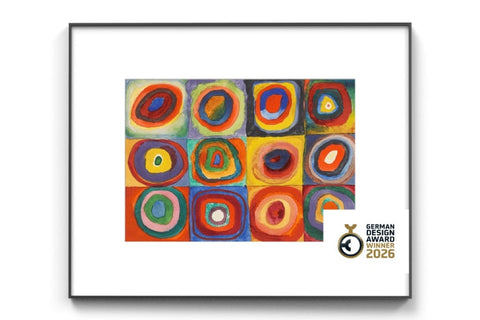
Image: Wassily Kandinsky. Farbstudie – Quadrate mit konzentrischen Ringen. Lenbachhaus, Munich. Public Domain
Style plays in too: InkPoster tends to fit modern, spare rooms, home offices, narrow halls, and bedrooms where a smooth, low-glare surface feels right, whereas canvas can feel more at home in classic rooms, layered spaces, or gallery walls where surface variation is part of the look.
Questions to Help You Decide
Do you want one artwork – or a wall that can keep changing? A canvas print is a commitment to one image. InkPoster takes a different approach: the frame stays, while the artwork can change whenever you feel like seeing something different. A photograph today can become a painting, poster, or new discovery tomorrow.
How often would you really update the art? If you rarely change artwork, both canvas and InkPoster can work well – the difference is that InkPoster gives you the option whenever you want it. If you like changing what you see with the season, your mood, or simply when you discover something new, that flexibility becomes part of the appeal.
What kind of room is this for? InkPoster makes most sense when you want the piece to feel part of the room while keeping the option to change it over time, whereas canvas makes sense when you are decorating around one key piece. In larger living spaces, the Affresco 31.5” is a natural fit.
What kind of art are you showing? InkPoster tends to be a strong fit for classic artworks, posters, graphic prints, and architectural images, while canvas can suit art copies where surface weave is part of the look.
Shop InkPoster
| Model | Size | Best for |
|---|---|---|
| Affresco 13.3” | 13.3” | Where a small framed print would otherwise go |
| Affresco 31.5” | 31.5” | Where a large canvas would otherwise anchor the wall |
| Tela 28.5” | 28.5” | A canvas-sized piece, with color depth closer to a print |
| Tela 40.5” (available soon) | 40.5” | Where an oversized canvas commission would otherwise go |
| Duna 40.5” (available soon) | 40.5” | A designed frame, not just a stretched canvas |
InkPoster holds a curated library of 2,000+ artworks on a matte, cable-free display that hangs like framed art and lets you change the image whenever the room calls for it. Browse all models at inkposter.com — no plan required.
Best Digital Art Poster 2025 — Esquire · Best Use of E Ink, CES 2025 — The Verge

© Pininfarina.
FAQ
Does InkPoster look as good as a canvas print?
InkPoster reads much like a well-printed framed image seen in room light, offering a smooth, matte surface rather than canvas weave. From across the room it reads like wall art, while up close canvas shows more surface texture and depth — so the two surfaces suit different kinds of art and different room types.
Can I put my own photos on InkPoster?
Yes. InkPoster takes personal image uploads through the app, resized and set for the matte surface, and slideshow mode is supported with flexible timing. Artwork and natural-tone photos work especially well.
Is a canvas print less costly than InkPoster per image?
The two serve different needs: canvas is a one-image format, whereas InkPoster is designed for people who want to change art over time without buying a new piece each time, and the curated art set carries no per-image fee after purchase.
Which should I choose — InkPoster or a canvas print?
It comes down to how you want to live with the wall. InkPoster suits a flexible art set: a matte surface, no cables, and a curated library of 2,000+ artworks that can change whenever the room calls for something different.
Making the Call
If your wall should change over time, InkPoster’s curated library of 2,000+ artworks and cable-free battery life are the deciding factors. Compare current models and pricing.
Header image: Gustav Klimt. Der Kuss (Liebespaar). Belvedere Museum, Vienna. CC0, Public Domain


