

Battery Powered Digital Picture Frame: How Long It Lasts and What to Look For
A battery powered digital picture frame runs on a built-in rechargeable battery instead of a power cord. How long it lasts depends mainly on its screen: a backlit frame needs ongoing power while the display is on, whereas a reflective ePaper frame such as InkPoster uses power only when the image changes and can run for up to a year between charges. That is what lets a frame hang anywhere — above a mantel, on a stairwell wall, or in the middle of a wall that was never wired.
This guide explains why battery life varies so much, what to look for when you buy a digital frame, how photos look on an ePaper display, and where a cordless frame makes the biggest difference at home.
Key takeaways
- Battery life depends mainly on the display: a backlit screen needs power while operating; an ePaper screen needs no power to keep an image displayed.
- InkPoster uses a color E Ink Spectra 6 screen, can run for up to a year between charges, and keeps its image on display even in power-off mode.
- Look for battery life measured in months, easy USB-C charging, a glare-free matte screen, and simple app control.
- Cordless frames suit fireplaces, stairwells, large walls, bedrooms, and rented homes.
Why Does Battery Life Vary So Much Between Frames?
The single biggest factor in a battery frame’s life is how its screen makes an image. Backlit screens shine light through the picture for as long as it is on display, so they need ongoing power while illuminated. Their battery life therefore depends on screen brightness, battery capacity, and how long the display stays on.
A reflective ePaper screen works the other way. It forms the picture from tiny pigment particles that settle into place and then stay there without any power at all, the way ink stays on a printed page. Energy is used only while the picture changes, so a frame that changes its image a few times a day spends almost all of its time drawing no power.
That is why InkPoster can run for up to a year between charges, depending on how often the artwork changes, and why its image stays on display even in power-off mode. For a frame that is meant to live on a wall rather than a table, that difference decides whether cordless is a feature or an everyday chore.
What Should You Look For in a Battery Powered Frame?
A cordless frame should be judged on how it will live in your home, not only on its specifications. These are the points that matter most.
Battery life in real use. Look for a frame whose battery is measured in months rather than hours, so it can stay on the wall without a daily routine of charging. With ePaper, the rhythm of image changes sets the pace: a slideshow that changes every few hours uses more charge than one piece shown for a week.
How it charges. A frame that hangs on a wall should be easy to take down and charge. InkPoster charges over USB-C, and the app shows battery life so you know well in advance when a charge is due.
Screen type and glare. Glossy screens catch reflections from windows and lamps, which makes a picture hard to see from across the room. InkPoster’s glare-free, matte, paper-like screen reads like a real print on paper in daylight and under lamps alike.
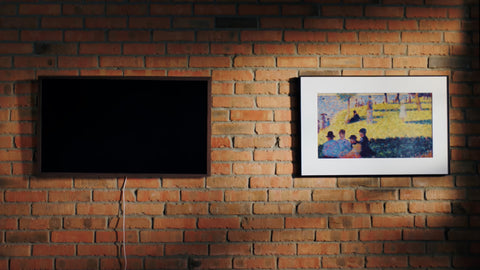
Image: Georges Seurat. Group of Figures. Courtesy of the Barnes Foundation, Merion and Philadelphia, Pennsylvania. CC PDM 1.0. Public Domain
Size. Because a reflective ePaper screen holds an image without power, larger cordless displays are practical for wall placement. InkPoster offers 13.3”, 28.5”, and 31.5” formats, with the 40.5” A1 Tela and Duna available soon.
How you add pictures. Adding images should be simple. In the InkPoster app you can add an image from your phone’s camera roll, switch images, set a timed slideshow, and check battery life.
What it can show besides photos. A frame that also shows art is useful on days when you want the wall to change mood. InkPoster includes a curated gallery of up to 2,000 hand-selected, licensed artworks, from masterpieces by Van Gogh, Monet, and Klimt to contemporary work and vintage posters.
How Does an ePaper Frame Compare With a Backlit Frame?
Both kinds of frame can run without a cord, but they are built for different ways of living with a picture.
| Feature | ePaper frame (InkPoster) | Backlit battery frame |
|---|---|---|
| How the image forms | Pigment reflecting room light | Backlight shining through a screen |
| Power for a still image | None needed to hold the image | Ongoing while operating |
| Battery rhythm | Up to a year between charges, depending on image changes | Depends on battery capacity, brightness, and screen-on time |
| Look on the wall | Matte, glare-free, print-like | Lit display; surface finish varies by model |
| When switched off | The image stays on display | The screen goes dark |
| Built for | Photos and art that change by choice, including slideshow | Frequent image changes and, where supported, motion |
The comparison is less about better or worse and more about purpose. A backlit frame suits motion and rapid slideshows on a table near a charger, while a battery powered ePaper frame suits a wall where the picture should simply be there, like a framed print. For a closer look at the display technology itself, see our guide to the E Ink display.
How Do Photos Look on an ePaper Frame?

Image: Gustav Klimt. Der Kuss (Liebespaar). Belvedere Museum, Vienna. CC0, Public Domain Vincent van Gogh. Self-Portrait with a Straw Hat. 1887. Courtesy of Pictufy.com
Because an ePaper frame builds color from pigment, photographs take on a character closer to a printed image than to a phone screen. Colors look natural and settled, with a paper-like quality close to gallery artwork, and up close you can see a fine, print-like texture that gives the picture the feel of ink on paper.
Some images suit the surface especially well. Black-and-white photography, landscapes with clear shapes, travel pictures with strong light, and graphic compositions all sit comfortably on it, while very soft gradients show that print-like texture more clearly. Many people mix family photographs with artworks from the gallery, so the frame can show a holiday picture one week and a painting the next.
Reviewers have noticed the print-like effect. Wired wrote that
Texture reads well, colors feel settled, and the overall effect is much closer to printed paper than a screen.
Where Does a Cordless Frame Make the Biggest Difference?
A battery powered frame earns its keep wherever a cable would be awkward, visible, or impossible. Some of the most common spots at home include:
- Above a fireplace, where there is rarely an outlet and a cord down the chimney breast would spoil the look.
- Stairwells and landings, which are almost never wired for anything on the wall.
- The middle of a large wall, where the best position for a picture is far from any socket.
- Bedrooms and children’s rooms, where a frame with no harmful blue light and no flicker, heat, or noise is comfortable to live with.
- Rented homes, where running new power to a wall is not an option.
In each case, the frame goes where the room’s design wants it rather than where the wiring allows. As the Financial Times put it:
Forget any preconceptions you may have about digital frames – not least trailing cables and narrow viewing angles.
Shop InkPoster
| Model | Size | Best for |
|---|---|---|
| Affresco 31.5” | 31.5” | A striking accent on a main wall |
| Affresco 13.3” | 13.3” | Shelves, desks, and small, cozy corners |
| Tela 28.5” | 28.5” | Living areas and open spaces |
| Tela 40.5” (available soon) | 40.5” | A centerpiece for spacious interiors |
| Duna 40.5” (available soon) | 40.5” | Luxury interiors, a natural fit for Duna’s Pininfarina design |
Every model is cordless and includes the curated gallery and app control.
Browse all models at inkposter.com
Best Use of E Ink, CES 2025 — The Verge · Best Digital Art Poster 2025 — Esquire
FAQ
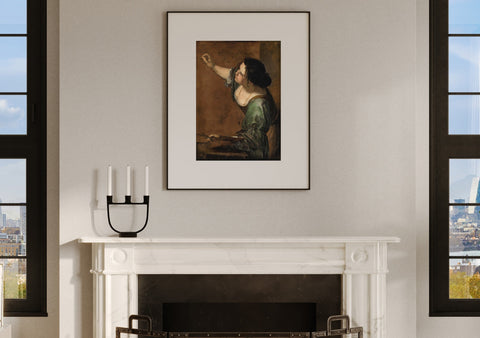
Image: Artemisia Gentileschi. Self-Portrait as the Allegory of Painting (La Pittura), c. 1638–1639. Oil on canvas. Royal Collection, Buckingham Palace, London. Wikimedia Commons, https://commons.wikimedia.org/wiki/File:Self-Portrait_as_the_Allegory_of_Painting_(La_Pittura)_-_Artemisia_Gentileschi.jpg . Accessed 01.07.2025. Public Domain.
How long does a battery powered digital picture frame last?
It depends on the screen. Backlit frames need ongoing power while operating, while an ePaper frame uses power only when the image changes. InkPoster can run for up to a year between charges, depending on how often the image changes.
Do battery powered digital frames need to be plugged in?
Only to charge. An ePaper frame such as InkPoster hangs cordless — no power outlets needed nearby — and is taken down occasionally to charge over USB-C.
Does the picture disappear when the frame is off?
On an ePaper frame, the image stays on display even in power-off mode, because the screen needs no power to hold a picture. The app shows battery life so you can charge in good time.
Can I put my own photos on a battery powered frame?
Yes. With InkPoster you add images from your phone’s camera roll through the app. Photos appear with a fine, paper-like texture, which gives them the look of a printed image rather than a glossy screen.
Is a battery powered digital frame good for a bedroom?
An ePaper frame suits a bedroom well: it adds no light after dark, has no harmful blue light, and once an image is set there is no flicker, heat, or noise.
Can a large digital frame run on battery?
Yes, with ePaper. Because the screen holds an image without power, large formats are practical on battery. InkPoster offers 13.3”, 28.5”, and 31.5” models, with 40.5” models available soon.
Choosing Your Cordless Frame
A battery powered digital picture frame is only as good as its screen. If you want a frame that hangs anywhere, looks like a print, and stays on the wall for months between charges, explore InkPoster’s models and sizes.
Header image: Image: © Carmine Chiriacò. Courtesy of 1x.com


